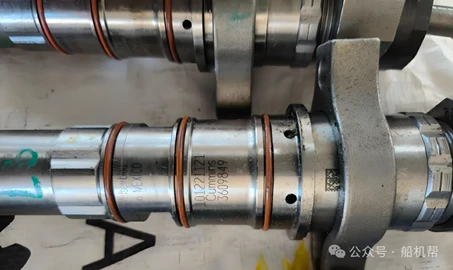
The adjustment of the fuel injection stroke of the injectors in the PT fuel system of Cummins diesel engines has three methods. The traditional methods are the stroke measurement adjustment method (referred to as the stroke method) and the torque adjustment method (referred to as the torque method). When using these two methods for adjustment, not only do they require the use of specialized instruments and meters, but also their accuracy is unsatisfactory when adjusting diesel engines with a long operating time.
After comparing them here, we recommend a new adjustment method - the angle method.
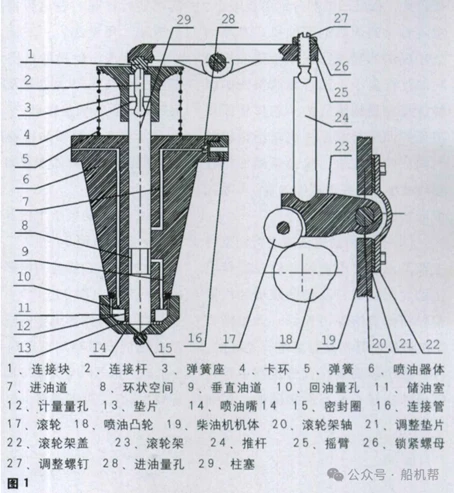
The adjustment of the injection stroke of the Cummins diesel engine is of great significance. It directly affects the performance of the diesel engine. If the adjustment is inaccurate, either the stroke is too large or too small (as shown in Figure 1, that is, the pressure exerted by the injector plunger 29 on the bottom of the injector nozzle 14) will have adverse effects on the diesel engine, such as abnormal operation, reduced power, and even inability to operate.
The specific manifestations are as follows:
If the travel is too large (that is, the squeezing force between the injector plunger 29 and the bottom of the injector nozzle 14 is too small or there is a gap), it will cause the nozzle 14 to have a clogged spray hole.
When the plunger 29 descends, it cannot fully squeeze the bottom of the nozzle 14, resulting in the diesel remaining in the nozzle 14 and its spray holes not being able to be completely sprayed out. The diesel that enters the cylinder will burn to produce high-temperature and high-pressure gas. This gas will flow back through the spray hole, causing the diesel in the spray hole to be incompletely heated and burned, resulting in carbon deposits. Over time, the spray hole will be partially or completely blocked.
If the stroke is too small (meaning the piston exerts too much pressure on the bottom of the fuel injector), it can cause damage to the fuel injector 14 or even result in it being crushed.
The fuel injectors of the Cummins diesel engine achieve fuel injection through the action of the fuel injection cam 18, the roller frame 23, the push rod 24, and the rocker arm 25, which push the plunger 29. If the fuel injection stroke adjustment is too small, the pressure exerted by the plunger 29 on the bottom of the fuel injector 14 is too great. The plunger 29 may damage the fuel injector 14 or the part of the bottom fuel holes, causing damage to the sealing surface at the bottom of the fuel injector 14 or the crushing of the fuel holes. The crushed metal may fall into the cylinder, which will cause severe knocking in the diesel engine, and even damage the piston, cylinder head and cylinder liner.
This phenomenon occurs when adjusting using the stroke method
or the torque method.
Why does it tend to cause the fuel injection stroke to be too large or too small?
The main reasons are as follows:
(1) When using the travel method for adjustment, it was mainly overlooked that the wear of the fuel injection camshaft is not uniform.
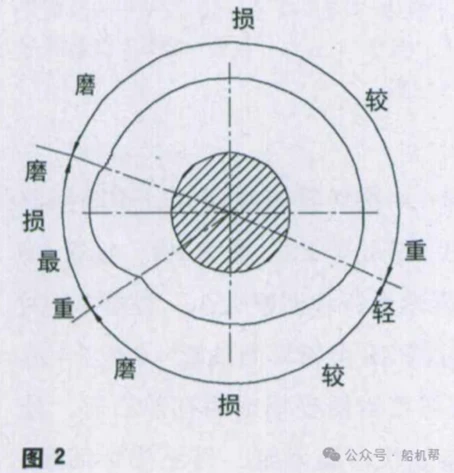
Refer to Figure 2. Under normal circumstances, the wear of the contour of the cam is uneven. The pressure between the protruding part and the roller 17 (Figure 1) is greater, while the pressure in the concave part is smaller. Therefore, the wear degree of the protruding part is relatively greater than that of the concave part. Conversely, the concave part wears less. After a diesel engine has been running for a long time, the injection stroke provided by the injection cam is smaller than that of a new diesel engine. The adjustment stroke of the stroke adjustment method is a fixed value. Therefore, if the adjustment stroke is adjusted according to the fixed value for a diesel engine that has been running for a long time, the injection stroke will be relatively reduced. This will cause the carbon deposits to accumulate in the injection hole of the injector 14.
(2) When using the torque method for adjustment, the differences in the tightness of the adjusting screw and the locking nut when they are twisted on the rocker arm, as well as the differences in the spring force, were not taken into account.
The tightness of the adjusting screw varies each time it is adjusted, and the torque of the locking nut for each injector during the adjustment process is also different. Additionally, the cleanliness of the assembly of the adjusting screw and the locking nut is also not the same. Therefore, when the adjusting screw is twisted on the rocker arm, there are differences in its tightness. Thus, when using the torque method for adjustment, although the torque data used is the same, the compression force of each piston on the bottom of the fuel injector 14 is different. Some are too tight, and some are too loose.
For each piston, the compression force of the piston on the bottom of the fuel injector 14 after multiple adjustments will not be completely the same. There will still be some that are too tight and some that are too loose.
How can the fuel injection stroke of the injector be accurately adjusted?
Here, we recommend a new method: the angle method.
The angle method is a way to adjust the fuel injection stroke by screwing the adjustment screw 27 into position so that the plunger 29 just touches the bottom of the fuel injector 14, and then turning the adjustment screw 27 clockwise by a certain angle (see Figure 1).
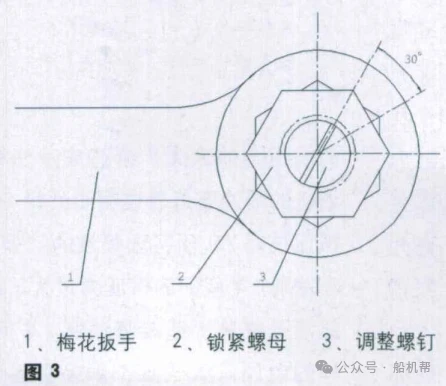
The specific steps are as follows (see Figure 3):
(1) Use the combination wrench 1 to loosen the locking nut 2 by 4 to 5 turns (see Figure 3).
(2) Use a flat-head screwdriver to loosen the adjustment screw 3 by 1 to 2 turns (see Figure 3).
(3) Locate the injector that needs adjustment. Rotate the crankshaft to align the timing pulley with the timing mark, ensuring that the intake and exhaust valves of cylinder 1 are fully closed (i.e., the rocker arms of the intake and exhaust valves are loose). Then, adjust the stroke of the injector in cylinder 1.
(4) Place the screwdriver on the loosened adjustment screw 3, and slowly turn it in with one hand (see Figure 3). Stop immediately when you feel a sudden resistance (this is when the plunger has just touched the bottom of the fuel injector 14 as shown in Figure 1).
(5) Place the twelve-point wrench on the locking nut 2. Do not tighten it. Remember the direction in which the screwdriver inserted into the slot on the adjusting screw 3 and the position where it aligns with the combination wrenches 1.
(6) Keep the combination wrenches 1 stationary, and turn the adjusting screw 3 clockwise by an angle of 30 degrees in a clockwise direction.
(7) Repeat (2), (4), (5), (6) three times to ensure the adjustment is accurate.
(8) Keep the adjusting screw 3 in place and tighten the locking nut 2.
(9) Repeat steps 1 to 8, and in the order of (1), (5), (3), (6), (2), and (4), adjust each fuel injector of the diesel engine according to the markings A, B, and C (for other multi-cylinder engines, the corresponding cylinder adjustments can be made according to their ignition sequence).
The adjustment method of the angle approach avoids the drawbacks of the travel method and the torque method, which adjust through fixed values. After the plunger just touches the bottom of the fuel injector 14, the rotation angle of the adjusting screw is directly adjusted. Essentially, it directly adjusts the compression degree between the fuel injector plunger and the bottom of the fuel injector 14. This significantly reduces the adjustment errors caused by various reasons.
However, due to the fact that all manual adjustments do not require any special tools, those who need to make the adjustments must have certain maintenance experience to carry out accurate adjustments.
After conducting tests at the site, it was found that the diesel engine adjusted by this method operated normally after 2000 hours of operation. When the fuel injectors were removed for inspection, no clogging of the injection holes was observed.