1, Key points of maintenance and repair
1. Daily inspection
Oil and coolant: Check the oil level (recommended SAE 15W-40, API grade CF4 or higher) and coolant freezing point daily (must be at least 10 ℃ below ambient temperature).
Air intake system: Regularly clean or replace the air filter to avoid dust causing engine wear.
Fuel system: Daily discharge of water from the oil-water separator to prevent blockage of the oil circuit due to ice formation in winter, and select appropriate grade diesel according to the temperature (such as -20 grade diesel suitable for -14 ℃~-29 ℃).
2. Regular maintenance cycle
Every 250 hours: Change the engine oil, oil filter, fuel filter, and water filter; Check the concentration of coolant DCA (recommended 0.32-0.79 units/liter).
Every 1500 hours: Adjust valve clearance and injector lift, and check key components such as turbocharger and water pump.
Every 4500 hours: Fully calibrate the fuel injection pump and fuel system, replace vulnerable parts such as turbocharger bearings, pulleys, etc.
3. Winter special maintenance
Use low freezing point antifreeze (such as -40 ℃) to avoid freezing of the cooling system; Choose low viscosity engine oil (such as 10W-30) to improve cold start performance.
2, Key maintenance data
Oil pressure: Within 15 seconds after starting, it should be higher than the minimum required pressure (refer to the model manual for specific values).
Installation of front oil seal of the crankshaft: Special tool (part number 3163485) is required, with an installation torque of 108N · m, to ensure that the seal is flush with the gear chamber cover.
Fuel system parameters: Fuel viscosity 1.3-5.8cSt (40 ℃), cetane number ≥ 40, sulfur content ≤ 0.5%
3, List of commonly used accessories and tools
1. Core accessories
Filters: oil filter (full flow/combination), fuel filter, air filter.
Seals: front/rear oil seals of crankshaft (part number 3803994), RTV silicone sealant (part number 3164067).
wear-out part: turbocharger bearings, pulleys, piston rings (special compression tool 3822736 is required).
2. Specialized maintenance tools
Cylinder liner installation tool (part number 3823615), piston ring expander (3823871).
Crankshaft gear puller (part number 3165049), crack detection kit (3375432).
Diagnostic tool: INSITE ™ The software (part number 3825145) is used to read fault codes and adjust ECM parameters.
4, Precautions
1. Avoid operational errors
The thermostat cannot be removed: Removing it will cause the engine to run at low temperatures for a long time, exacerbating wear and increasing fuel consumption.
Shutdown standard: After heavy load, idle for 2-3 minutes before turning off the engine to prevent damage to the turbocharger.
2. Circuit and harness maintenance
The ECM power cord must use wires with a specification of ≥ 12AWG and a total resistance of ≤ 0.04 Ω; Check for loose wiring of the ignition lock (common cause of high-frequency non-current fault code 434).
The J1939 harness needs to be shielded and grounded, with a terminal resistance of 120 Ω, to avoid communication interference.
3. Fault diagnosis priority
The current fault code needs to be dealt with immediately (such as low oil pressure); Non-current code needs to be combined with historical data to identify potential hazards
5, Summary
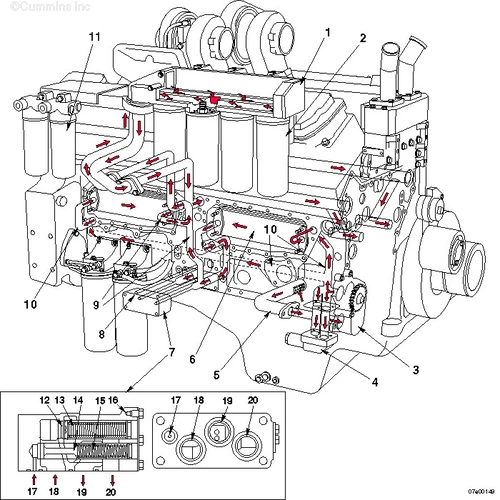
The reliability of Cummins QST30 engine relies on scientific maintenance and standardized repair. By regularly replacing filters, selecting compliant oils, using specialized tools to disassemble key components, and combining with INSITE ™ Software precise diagnosis can significantly extend engine life. Lubrication system flowchart:
Upper Engine Gasket Kit 3804718
Lower Engine Gasket Set3804938
Piston Ring Set - Standard3804708
Injector - Standard 4025279
Injector - Standard 4025280
Turbocharger4033508