
Introduction
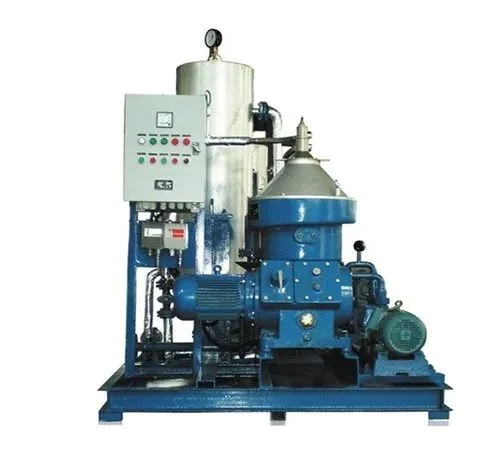
Model of fuel separator for a certain round:
Al fa Laval SA 821, automatic slag removal, with a 60Hz AC power supply, the motor speed is 3600rpm, and the maximum speed of the separator is 8400rpm. It adopts a coupling and belt transmission method instead of traditional worm gear and worm gear transmission, which saves the complex and cumbersome transmission gearbox and makes disassembly and maintenance more convenient and fast.

1, Fault process
One day, during the sea voyage of the vessel, the oil separator was operating with severe vibration, increased noise, poor slag removal effect, and a high vibration fault alarm was issued.
The engineer first confirmed that there was no looseness in the anchor bolts, and based on the fact that the noise came from inside the engine, decided to disassemble and repair the oil separator.
After disassembly, it was found that the separation plate was dirty, the water distribution plate hole was slightly blocked, and scaling was also severe. After pulling out the vertical shaft for inspection, it was found that the upper ball bearing had slight wear, while the lower ball bearing had more severe wear.
Therefore, it is determined that high vibration noise is caused by bearing wear.
Subsequently, the second engineer was responsible for replacing the two ball bearings on the vertical shaft, and cleaning the water distribution plate and the water holes for unblocking the sealing water and opening the water.
After the cleaning and replacement work is completed, the overall installation of the oil separator is carried out, and then the oil separator is started for trial operation, running for approximately 1-2 minutes.
However, the situation did not improve and instead worsened.
The noise and vibration of the oil separator became sharper and more severe, and the alarm still did not disappear. Therefore, the operation of the oil separator was immediately stopped, and the disassembly and troubleshooting of the oil separator continued.
2, Troubleshooting analysis
There are many causes of vibration faults in the oil separator, but most of them are caused by unreasonable assembly clearances and wear. Therefore, troubleshooting also focuses on checking the wear and assembly clearances of various components.
Generally speaking, due to the prolonged oil separation time of the oil separator, the uneven distribution of residue in the separation cylinder of the oil separator causes imbalanced rotation of the oil separator, resulting in a loss of centrifugal force, which is the most common cause of oil separator vibration.
However, due to the recent cleaning of the separation cylinder, the vibration alarm has not been eliminated, so this situation can be ruled out.
Firstly, check if the separation cylinder is installed properly, pull out the separation cylinder, and it is found that there is no wear inside and it operates well.
Reinstall the separation cylinder and recheck its installation components to prevent mixing with other separation cylinder components. It was confirmed that this situation did not occur.
According to the instructions, it has been ensured that it is installed correctly and in place.
Therefore, the reason for vibration caused by poor installation of the separation cylinder is ruled out.
Pull out the vertical shaft again, the surface of the shaft is smooth and there is no obvious wear.
Then use a feeler gauge to measure the gap between the vertical shaft and the bearing liner hole, and the value meets the requirements of the manual.
The parallelism of the vertical shaft was also checked, and its parallelism is within the scope of the manual, so the reasons for wear and bending deformation of the vertical shaft are ruled out.
No results were found in the inspection, and the vibration damping spring at the lower cover plate of the vertical shaft was also checked, but no spring fracture or insufficient spring force was found.
After ruling out all possible scenarios mentioned above, it is suspected that there may be a sensor malfunction causing a false alarm.
However, as there are no spare sensors on board, the sensor parameter Fa16 can only be adjusted to 0.0 to reduce its sensitivity and reduce the possibility of false alarms.
But the alarm has not been eliminated yet.
Finally, two additional separation plates were experimentally added, and to my surprise, the vibration was reduced.
Originally, during the first dismantling and cleaning of the oil separator by the second engineer, the sealing gasket at the locking nut on the upper part of the vertical shaft was mistakenly replaced.
Resulting in a change in the vertical axis height and an increase in the gap between the separation plate and the separation cover plate.
During high-speed centrifugal rotation, the separation plate rubs against the cover plate, causing severe vibration and noise.
After identifying the cause, the second wheel was immediately brought in, appropriate separation plates were installed, and the height of the vertical shaft was adjusted within the specified range.
The alarm was indeed lifted.
3, Issues to be noted in maintenance management
(1) From the resolution of this fault, it can be seen that high-speed rotating machinery on ships, such as oil separators and turbochargers, must strictly follow the instructions for their gaskets and appropriate clearances.
(2) For infrequent faults, it is necessary to carefully analyze them step by step according to the instructions, clarify the functions of each component and the working principle of the system, until the true cause of the fault is identified.
(3) Engine management personnel should be familiar with the machinery of the ship they are managing, regularly check whether it meets the requirements, and establish a sense of responsibility.
Because even small problems can lead to significant mistakes.
Pay more attention to details and communicate effectively with other management personnel.