
The net profit reached a new high of 4.2 billion yuan, with outstanding orders exceeding 160 billion yuan! Amid the turmoil in the global shipbuilding industry, Yangzijiang Shipbuilding demonstrated strong resilience. In the first half of the year, the net profit of Yangzijiang Shipbuilding Group achieved a significant increase, and the overall operating performance maintained a steady improvement.
On the evening of August 6th, Yangzijiang Shipbuilding (Holdings) Co., Ltd. released its financial performance report for the first half of the year. The financial report data showed that in the first half of 2025, the total revenue of Yangzijiang Shipbuilding Group remained relatively stable, at 12.9 billion yuan, with a slight decrease of 1.3% compared to the previous year; the net profit attributable to shareholders of the company increased by 37% year-on-year, reaching a record high of 4.2 billion yuan.
Yangzijiang Shipbuilding explained that the reduction in revenue in the first half was mainly due to the change in the product structure of the core shipbuilding sector, resulting in a slight decline in revenue contribution. In the first half, the revenue of the core shipbuilding sector was 12.25 billion yuan. Specifically, the launch of oil tanker construction projects had an impact on revenue, as the average unit price of this type of ship was lower than that of container ships. It is worth noting that the revenue contributed by the construction projects of large-scale dual-fuel container ships, which have higher technical content and more favorable prices, largely offset the aforementioned decline impact.
In the first half of the year, the revenue of the shipping segment of Yangzijiang Shipbuilding was 510 million yuan, a year-on-year decrease of 15.4%, mainly due to the weakening of charter rates. The revenue from other businesses (including trade, ship design services, and investment properties) increased significantly by 153.2% year-on-year to 117.1 million yuan, mainly benefiting from the increase in trade activities related to the raw material sales with the associated joint venture company TSUNEISHI Shipbuilding.
In contrast, Yangzijiang Shipbuilding's gross profit increased by 27.6% from 3.5 billion yuan in the first half of 2024 to 4.4 billion yuan in the first half of 2025; the gross profit margin rose by 7.8 percentage points to 34.5%. The improvement in the gross profit margin was mainly attributed to the decline in steel costs, the smooth execution of orders and the improvement in prices, as well as the successful delivery of large dual-fuel container ships.
In the first quarter of this year, Yangzijiang Shipbuilding completed the capital injection into TSUNEISHI Shipbuilding, and TSUNEISHI Shipbuilding has now officially become a joint venture company of Yangzijiang Shipbuilding with a 34% stake. With the addition of TSUNEISHI Shipbuilding, the profit share of joint venture and associated companies of Yangzijiang Shipbuilding increased by 79.0% year-on-year to 481.4 million yuan, mainly contributed by Yangzijiang Shipbuilding with a profit of 320 million yuan and TSUNEISHI with a profit of 160 million yuan.
Against this backdrop, Yangzijiang Shipbuilding's net profit attributable to shareholders increased by 36.7% year-on-year in the first half of 2025, from 3.1 billion US dollars in the first half of 2024 to 4.2 billion US dollars. As of June 30, 2025, the group's balance sheet remained stable, with a net cash holding of 18.3 billion yuan.
Affected by factors such as an excessively high order base in 2024 and market sentiment, in the first half of 2025, Yangzijiang Shipbuilding received 14 new orders, valued at 540 million US dollars (approximately 3.879 billion yuan), and only achieved 9% of its annual order target of 6 billion US dollars. Most of the new orders in the first half were for medium and small-sized ships, including 12 container ships (8 1700 TEU, 2 3000 TEU and 2 4488 TEU), and 2 83000 deadweight ton bulk carriers. Yangzijiang Shipbuilding will flexibly adjust its business strategy and is confident in formulating reasonable plans for the target ship types of the three shipbuilding bases, and efficiently utilizing the remaining ship berths and platforms.
In the first half of 2025, Yangzijiang Shipbuilding delivered a total of 23 new ships, achieving 41% of its annual delivery target of 56 ships. As of now, all the new ship construction projects of the company are advancing steadily according to the established plans, and all ship delivery plans are in normal execution status. It is expected to complete the annual delivery target on schedule.
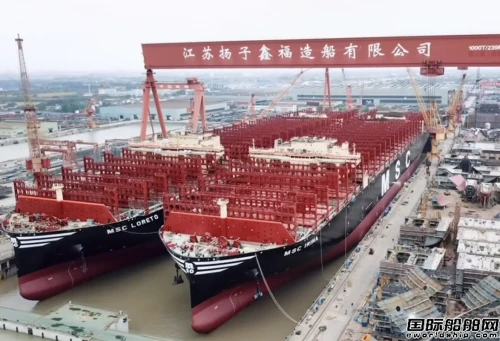
As of June 30th, Yangzijiang Shipbuilding had 236 vessels with a total contracted capacity of 879,000 CGT, valued at 23.2 billion US dollars (approximately 166.649 billion RMB). The delivery schedule extends to 2030. The types of vessels on its backlog are diverse, including 107 container ships valued at 15.97 billion US dollars, 39 bulk carriers valued at 1.63 billion US dollars, 26 liquefied gas carriers (LEG ships/LPG ships/VLAC/VLEC) valued at 2.38 billion US dollars, and 64 oil tankers valued at 3.23 billion US dollars. Among them, green and clean energy vessel types account for approximately 74% of the total value of the backlog.
Meanwhile, the joint venture shipyard Yangzijiang Mitsui Shipbuilding has 57 vessels with a total contracted capacity of 1.25 million CGT, valued at 3.11 billion US dollars (approximately 22.340 billion RMB), including 17 LPG ships, 4 88,000 cubic meter ultra-large liquid ammonia transport ships (VLAC), 6 MR type product oil tankers, and 30 bulk carriers. Based on the order value, approximately 51% are liquefied gas ships, with the delivery schedule extending to 2029.
Yangzijiang Shipbuilding stated that the global shipbuilding industry is currently facing a complex situation in the short term, intertwined with macroeconomic uncertainties and geopolitical tensions. In the first half of 2025, global new ship orders decreased by 54%, mainly due to growing concerns about the potential impact of US tariffs on global trade volume. Additionally, the US plan to impose huge port fees on Chinese-built ships has also prompted shipowners to seek alternative solutions, despite limited shipbuilding capacity outside of China, which remains a major constraint.
Nevertheless, in the long term, new shipbuilding demand is still supported by the structural transformation of the industry towards decarbonization. The International Maritime Organization (IMO) is advancing the net-zero emissions framework, promoting mandatory emission limits and greenhouse gas (GHG) pricing mechanisms across the industry.
Yangzijiang Shipbuilding Group's Chairman and CEO Ren Letao stated that in the first half of 2025, facing complex challenges such as global shipping market fluctuations and international policy risks, the company has always focused on the core goals of "ensuring ship delivery, ensuring order acquisition, and ensuring projects", through a series of measures such as optimizing production processes, strengthening supply chain collaboration, and implementing meticulous management, continuously improving the efficiency and quality of shipbuilding. During this period, the company's shipbuilding gross profit margin reached a new high of 35%.
In February this year, Yangzijiang Shipbuilding invested 3 billion yuan to build a new base - the Yangzijiang Hongyuan Green High-Tech Clean Energy Ship Manufacturing Base Project, which officially started construction. Currently, the construction of Yangzijiang Hongyuan is still progressing according to the plan, with the completion expected by the end of 2026. The first new ship of this factory is expected to be delivered in 2027. Yangzijiang Shipbuilding is actively planning and implementing new ship orders suitable for the construction of the Yangzijiang Hongyuan factory, which will further consolidate and expand the company's order acquisition competitiveness and backlog holding capacity.
In the future, Yangzijiang Shipbuilding will continue to closely monitor market trends, dynamically optimize business strategies, and accurately seize emerging market opportunities. Relying on a prudent business philosophy and a stable financial structure, it is committed to creating sustainable long-term investment returns for shareholders.