

In previous analyses, I have highlighted the key trends significantly impacting the current economic landscape, particularly constraining the development of production and imports. These factors include the high central bank key interest rates, which have reduced public and private investment in construction and mechanical engineering, as well as challenges in international payments, logistics, and a severe shortage of skilled labor.
Regarding the domestic bulldozer market in Russia, the production of bulldozers increased by 12% in the first three quarters of 2024, with a total of 689 units produced compared to 611 units in the same period of 2023. Russian companies collectively held a 25% market share. Specifically, the "Promtor" factory produced 374 units, a slight decrease of 2 units from the same period in 2023. In contrast, the DST-Ural factory saw a modest increase in bulldozer production, reaching 209 units, an 11% rise.
Notably, in 2022, JSC Concern Uralvagonzavod and Concern Tractor Plants established a joint venture, LLC Manufacturing Company Chelyabinsk Tractor Plant (LLC MCP ChTZ), on the ChTZ premises. During the reporting period, this joint venture assembled 100 bulldozers, tripling the output from the previous year. This marks the first positive outcome after several years of declining production at ChTZ. It is also worth noting that in the 2000s, Chelyabinsk Tractor Plant was the largest domestic manufacturer of bulldozers, with a production volume approximately 20 times higher than current levels.

The Chelyabinsk Industrial Tractor Plant (ChZPT) is a relatively small enterprise. Over two decades ago, it began specializing in the repair of ChTZ equipment. Subsequently, the factory expanded its operations to include the production of its own tractors. From January to September 2024, ChZPT assembled only 6 bulldozers, compared to 11 units during the same period in 2023. According to the manufacturer, the plant's current capacity allows for the production of up to 50 units annually.
ELAZ is a newcomer to the bulldozer market. To date, the factory has not significantly expanded its production scale: no bulldozers were produced in the first three quarters of 2024, while two units were manufactured in the previous year. The primary challenge lies in the hydraulic mechanical transmission system. Bulldozers developed and released before the special military operation initially relied on imported Dana gearboxes. Currently, efforts are underway to develop a domestically produced gearbox.
Historical Context
In the early 2000s, domestically produced bulldozers accounted for over 80% of the Russian market. The peak of Russian bulldozer production occurred during the construction boom of the 2000s. In 2007, production reached an all-time high of 4,309 units (for reference, the Soviet Union produced over 50,000 bulldozers annually). Unfortunately, after the significant downturn in 2009, the domestic industry has yet to recover to pre-crisis levels. The main reasons for this decline include the reduction in production at the Volgograd Tractor Plant, followed by its liquidation, as well as substantial decreases in output at the Chelyabinsk Tractor Plant (ChTZ). During the construction boom, ChTZ held the largest share of domestic bulldozer production-over 50%, with an annual output exceeding 2,000 units.
In the first half of 2024, the import volume of new bulldozers (excluding second-hand units) remained largely consistent with the 2023 levels: a total of 1,113 units were declared, representing a 2% decrease. In the first half of 2022, foreign supply declined significantly as manufacturers from countries deemed "unfriendly" withdrew from the Russian market. However, by the end of 2022, Chinese equipment suppliers managed to substantially increase imports. During the January to June 2024 period, deliveries of equipment from "unfriendly" countries decreased to just 26 units, of which 21 were Komatsu bulldozers.
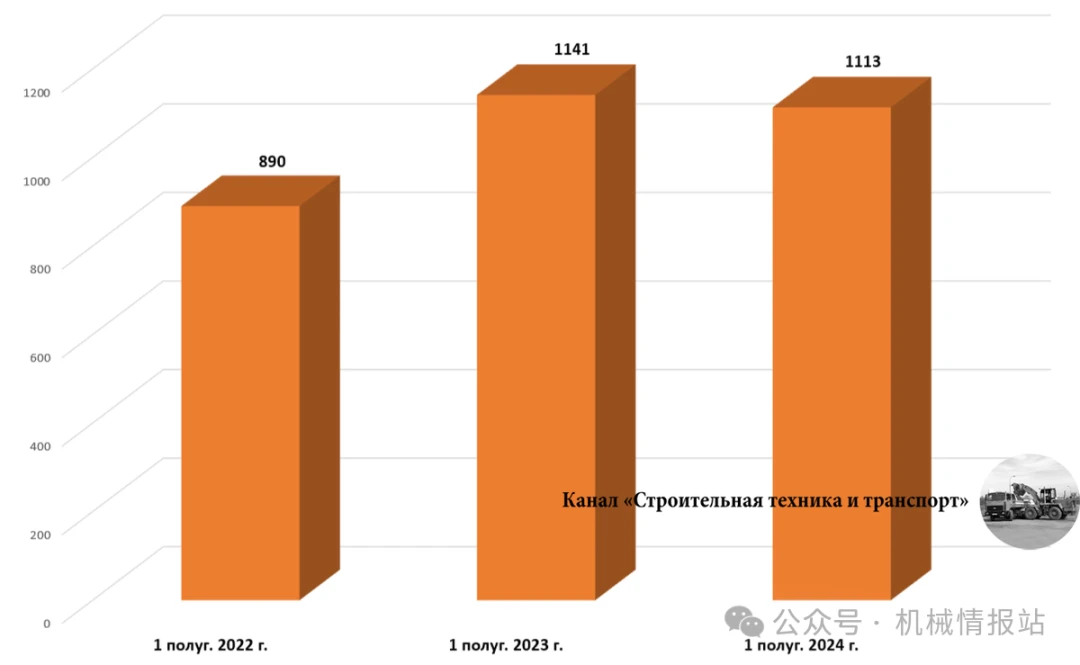
Import Dynamics of New Bulldozers in the Chinese Market (2022-First Half of 2024)
From 2022 to the first half of 2024, the import dynamics of new bulldozers into the Chinese market remained relatively stable. Shantui continued to lead with an import volume of 540 units, representing a 1% increase compared to the same period in 2023. Zoomlion imported 277 units, marking a significant 72% increase from the corresponding period in 2023. Liugong imported 119 units, a 19% decrease compared to the same period in 2023.
Previously, Shantong Machinery had been a notable supplier, importing 147 units in the first half of 2023, but this dropped sharply to only 4 units in the same period of 2024. Additionally, 151 units of bulldozers from other Chinese brands were imported during the first half of 2024. The import volume of second-hand bulldozers decreased significantly, from 24 units in the first half of 2023 to just 6 units in the same period of 2024.