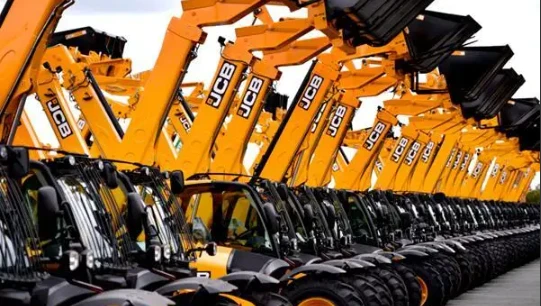
Since its establishment over 70 years ago, JCB (JCB) has been a global leader in engineering machinery, agricultural machinery, and industrial equipment. As a family of industrial innovation, JCB has invented many products that have influenced the world, such as excavator loaders, commonly known as "busy at both ends". JCB is synonymous with it in English. Today we will introduce JCB's other product that moves the world - the telescopic arm forklift Loadall.
JCB invented and sold the world's first telescopic arm forklift in 1977. Since its invention, this product has quickly become popular worldwide and has won unanimous recognition from customers worldwide. It is known as one of the "Three Musketeers" of small construction machinery. In 2016, JCB celebrated the 40th anniversary of the invention of the telescopic arm forklift after just holding the offline ceremony of the 200000th telescopic arm forklift. JCB will hold a series of major events to celebrate the 40th anniversary of the invention of telescopic forklifts.
Do you want to know how a telescopic arm forklift is produced? Do you want to know what processes are required to produce this world's best material handling equipment? Please follow in our footsteps and take a look at the production factory of JCB telescopic arm forklift.
40th anniversary of JCB telescopic arm forklift invention
One: Excellent production and manufacturing level
The Loadall telescopic arm forklift production factory is located at JCB headquarters in Rochester, Staffordshire, UK. At present, JCB has over 30 models of telescopic arm forklift trucks. In addition, due to the different optional configurations of engine, gearbox, boom, and cab, more than 1000 complete machine configurations have been derived. These telescopic arm forklift products with different configurations are all manufactured at the Rochester factory in the UK.
A high-quality equipment starts with high-quality steel. According to the production plan of information sharing, suppliers supply steel to JCB on a daily basis as needed. Steel is mainly used for producing the frame, legs, and boom of telescopic forklift trucks. JCB factory has an annual demand for steel exceeding 35000 tons.
As a manufacturer committed to vertical integration, JCB headquarters is also surrounded by JCB factories that produce engines, transmissions, axles, cabins, and hydraulic cylinders. The vertical integration of the supply chain enables JCB's R&D and design engineers to accurately calibrate and match, ensuring the best overall performance and highest productivity.
After the steel is delivered by truck, it is stored in a designated area with shielding and protection outside the factory building. According to the purpose, the steel plate will enter two production lines, one is the boom production line and the other is the frame and leg production line.
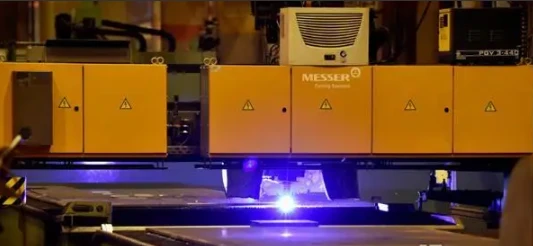
To ensure maximum utilization of steel, computer-aided calculation and planning are utilized before cutting steel plates, resulting in a material utilization rate of up to 77%. Cut discarded and useless boards, and the supplier will recycle and reuse them. Four computer-controlled laser cutting machines cut 15mm steel plates, while CNC plasma cutting machines cut 20-40mm steel plates. Recently, JCB invested over £ 1 million to purchase laser and plasma cutting machines. The latest plasma cutting machine can directly cut grooves, thereby improving the efficiency of subsequent welding processes.
After the cutting of the board is completed, it enters the bending process. A 650 ton stamping machine used for bending the structure of the boom box. In all manufacturing processes, workers must ensure the quality of their respective processes and be responsible to the "customers" of the next process.

The side of the boom will be spot welded and fitted with a liner before welding by the robot. Before welding the side of the frame, holes will be drilled in advance to create reserved positions. It takes an average of 45 minutes to make two side frames, and drilling and opening takes about 7-12 minutes. More than 70% of the frame and boom structure welding is completed by robots. However, some parts of the frame and boom that are difficult for robots to access require manual welding assistance. JCB Loadall requires 14509818 meters of welding wire annually, exceeding one-third of the length of the Earth's equator.

After the frame welding is completed, a pair of combination boring machines are used to drill holes for the installation point of the bottom support of the boom to ensure that the two holes can be perfectly aligned. Two CNC machining centers worth 1.2 million pounds, used for drilling and tapping the boom, waiting for assembly.
40th anniversary of JCB telescopic arm forklift invention
Part 2: JCB Classic Yellow Coating
In the fields of construction machinery and agricultural machinery, there are few colors that can be as recognizable as JCB yellow paint. In the following process, the boom, frame, and legs will enter a two-hour painting process. Firstly, remove external dirt through shot peening pretreatment to prepare for painting.
All components will be painted before assembly to ensure high-quality coating. JCB uses a two-component water-based paint coating process, and the Loadall production line requires 73000 liters of primer and 50000 liters of topcoat to be used annually. The painted parts will be baked in a 90-120 degree oven to ensure long-term and reliable protection of the equipment.

JCB Classic Yellow is the most commonly used color in painting, and customers can also customize personalized painting colors according to their needs. To reduce waste, personalized painting is generally aimed at bulk orders, but JCB painting lines can also provide personalized painting for individual equipment.
40th anniversary of JCB telescopic arm forklift invention
Thirdly: Efficient Loadall assembly line
The JCB Loadall structural component production line has 300 workers, while the assembly line has 460 workers. All assembly line workers are versatile and capable of completing at least three different tasks, allowing them to flexibly rotate between production lines.
The complete machine harness is the first part installed on the frame. The component packaging area is located on both sides of the main production line, preparing wiring harnesses, engines, transmissions, driver's cab, and axles for the assembly of the entire machine. The pre packaged components are launched according to the requirements of the main production line to ensure an orderly, smooth, and fast assembly process on the final assembly line.

On the assembly line, all sizes of Loadall can be produced in parallel, and different models can also share the same production line. The compact Loadall has an auxiliary production line.
The axle comes from JCB Rexham factory. Install the wheels onto the axle and then assemble it onto the frame. The next step is to assemble hydraulic valve blocks and components such as oil cylinders designed, manufactured, and produced by JCB.
The engines produced by JCB Power Systems, the transmissions produced by JCB Transmission Company, as well as other exhaust and auxiliary devices, are packaged in the packaging area.
The cab comes from the Rugeley factory. After the cab is packaged in the packaging area, it is installed on the entire machine together with the radiator. The boom assembly is parallel to the frame production line and can be installed with two, three, or four boom sections. After the support legs are installed, they can be assembled onto the frame.
JCB Loadall has over 3000 types of components and up to 1000 configurations, which makes the coordination of the entire production process very important. The assembly of Loadall is divided into 35 processes, and it takes about 8 hours for one device to go from online to offline. The assembly line has set up three main inspection points to ensure that each device meets JCB's quality standards.
40th anniversary of JCB telescopic arm forklift invention
Fourth: Strict testing process
After the equipment is assembled, add engine oil and various other liquids such as hydraulic oil, diesel, coolant, etc., and then start the engine. Each Loadall must first undergo a roller road simulation test, with the engine and gearbox undergoing a 13 minute speed test to calibrate the drive system.
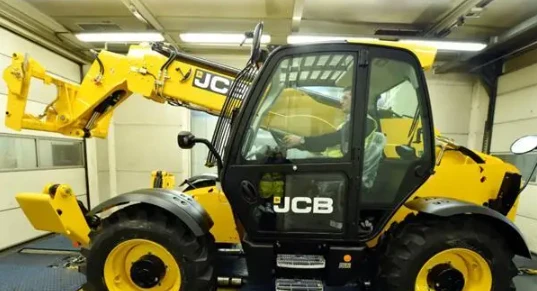
After passing the preliminary test, Loadall will enter the UV testing room to test the sealing performance of hydraulic components through ultraviolet radiation. When adding hydraulic oil, additives that are easily recognizable by ultraviolet radiation are also added. Therefore, it enables rapid detection of the sealing performance of hydraulic systems through ultraviolet radiation.
After the quality inspection is completed at this stage, components such as engine covers will be installed. Next, the equipment leaves the assembly line and enters the external testing area. In the upcoming external testing phase, a total of 10 inspectors will complete intensive operational testing. This includes warm-up testing, steering testing, weight testing, etc. The gravity test will allow the equipment to maintain its weight for 10 minutes at maximum height and maximum extension distance to verify its material retention capability. If accessories are ordered, they also need to undergo installation testing.
Next, the equipment needs to enter the second UV testing darkroom for UV sealing testing of hydraulic components. After completion, enter the pre shipment vehicle inspection PDI. PDI is a comprehensive inspection of the entire machine to ensure that it is ready for shipment at any time.
40th anniversary of JCB telescopic arm forklift invention
Fifth: Customer Focus Center
After the PDI program is completed, other brands can generally move the equipment into the shipping area or directly ship the equipment. However, JCB has done better.
In March 2016, JCB established the Loadall Customer Care Center. After completing the PDI pre testing equipment, it is necessary to enter the customer attention center for further inspection. At the customer attention center, equipment labels will be posted and personalized configurations will be completed, including toolboxes, lighting installations, and other optional devices to meet customers' special needs.

In order to ensure that customers receive the equipment in the best condition, JCB will conduct a full body car wash and take a series of pre departure photos before departure to ensure that there is no damage during transportation.
However, the true innovation of the customer focus center is the command center. Each Loadall is equipped with the JCB Livelink remote control system, and all device information data will be transmitted to the command center, including JCB Tech Web service information and customer call feedback from around the world. In order to better handle this information, there is a team dedicated to reviewing feedback from global clients.
Once the customer's concerns are confirmed, the team will immediately conduct a root cause investigation. If it is related to manufacturing, it will be quickly fed back to the factory. Afterwards, the command center will track and confirm the implementation of technological upgrades for the next batch of production equipment to ensure that the products are always maintained at the highest standards. This includes sending photos and work instructions to the tablet computers on the customer's attention center line, ensuring that equipment upgrades are validated and reviewed.
This system greatly improves the processing speed of customer feedback, while traditional methods require several weeks to receive feedback and improvement in the manufacturing system.