
1, Basic Overview
Model and type: 3408324 is an electronic actuator for Cummins PT fuel pump system, which is normally closed (throttle fully closed when power is off), low flow type (suitable for 200~300kW units), voltage 24V DC.
Applicable models: mainly equipped with Cummins engines such as M11, NTA855, KTA19, etc.
Core function: By adjusting the opening of the fuel pump rotor oil hole, the fuel flow entering the fuel injector is controlled, achieving precise adjustment of engine speed and power.
2, Working principle
Electromagnetic drive mechanism:
After direct current is applied to the coil, a torque is generated at the inclined end of the armature, which balances with the spring force and drives the rotor to rotate, changing the opening and closing degree of the oil hole and adjusting the fuel quantity.
The response time is only 15 milliseconds, ensuring rapid speed control response.
• Work status detection:
When powered on, it makes a crisp sound (2 normally closed sounds). If the sound is hoarse or there is no sound, it indicates internal card jamming or mechanical failure.
3, Structural characteristics and technical parameters
1. Core structure:
High precision friction pair clearance design requires flexible rotation, minimal clearance, and high surface smoothness. In the early days, the normally open type used a single column pivot shaft, while the normally closed type (such as 3408324) adopted a three joint universal joint structure, but in reality, it was prone to jamming and had a shorter lifespan.
Double O-ring seal: to prevent fuel leakage, lubricating grease should be applied during installation and bolts should be tightened strictly in sequence.
2. Key parameters:

4, Common Failure Modes and Analysis
1. Mechanical faults:
Card issuing/traveling: Due to impurities and moisture in the fuel, the bearings may rust or the friction surface may become stuck, resulting in speed fluctuations (traveling) and a sudden increase in cold idle speed (700-1000 rpm).
Oil leakage leads to idle loss of control: After wear and tear, the clearance increases, and the fuel leakage exceeds the required amount for idle. After unloading, the idle speed remains high (>900 rpm), and the load increases before it can return to normal.
2. Electrical faults:
Coil short circuit/open circuit: Abnormal resistance (close to 0 Ω or infinity), which may be caused by wire harness damage, plug oxidation, or internal burnout. Causing the ECU to report a fault code of "actuator circuit low voltage/short circuit", resulting in a decrease in engine power or inability to start.
Abnormal control signal: ECU drive circuit fault or poor grounding, check the harness resistance (should be>100k Ω) and signal voltage (>3V).
3. Matching and installation issues:
Conflict with control board type: A normally closed actuator paired with a normally open control board can result in "high-speed start" or inability to increase speed.
Improper tightening of bolts: Failure to tighten them step by step in the order of "bottom → left → right" (half tightening 2.8N · m → full tightening 5.6N · m) can easily cause seal failure or eccentric jamming.
5, Fault diagnosis and testing methods
1. Preliminary investigation process:
Listening to the sound: No clear double noise when powered on → Suspected of card jamming.
Resistance measurement: Disconnect the plug and measure the coil resistance (7.2 ± 0.4 Ω at 22 ℃). If it deviates, it needs to be replaced.
Check the oil circuit: Fuel filter blockage or water ingress can accelerate actuator wear.
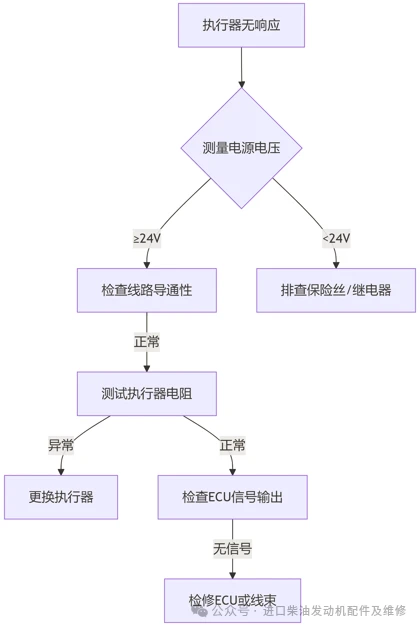
2. In depth diagnostic steps:
A [No response from actuator] -->B {Measure power supply voltage}
B -->| ≥ 24V | C [Check the continuity of the circuit]
B -->|<24V | D [Check fuses/relays]
C -->| Normal | E [Test actuator resistance]
E -->| Exception | F [Replace actuator]
E -->| Normal | G [Check ECU signal output]
G -->| No signal | H [Check ECU or wiring harness]
3. Application of special tools:
Use an OBD diagnostic tool to read fault codes (such as P0620), perform a override test to activate the actuator, and observe the pressure response.
6, Installation and maintenance specifications
• Installation points:
Replace the O-ring with a new one and apply lubricating grease. When inserting it into the pump casing, it is necessary to rotate and align it. After tightening the bolts step by step in sequence, it is necessary to "loosen half a circle and then tighten again".
• Measures to extend lifespan:
Fuel filtration: Regularly replace the filter to ensure that the fuel is free of impurities and moisture.
Alternative solution: For scenarios with low speed regulation requirements (such as oil fields), mechanical full range speed controllers or solenoid valve mechanisms can be used to reduce costs and extend lifespan.
7, Summary and Suggestions
The 3408324 Electronic Fuel Control actuator is the core electronic control unit of Cummins PT fuel system, and its faults are mainly caused by mechanical wear, electrical short circuits, and installation errors. During maintenance, it is necessary to strictly follow the torque sequence, ensure fuel cleanliness, and match the correct type of control board. For frequent card jamming or oil leakage, it is recommended to upgrade to wear-resistant improvement parts or switch to electromagnetic valve structure to enhance system reliability.