
Many have worked on ships for many years, but still don't know what fire isolation valves are for? What is his role and how to maintain him in daily life? Below, I will focus on introducing using pictures of a certain passenger ship as an example to illustrate. The convention requires that isolation valves used to separate the fire pipelines and other parts of the fire main pipeline arranged in mechanical spaces with main fire pumps or pump groups should be located outside the machinery space in easily accessible and controlled positions. The fire main should be arranged so that when the isolation valve is closed, all other fire hydrants on board can be supplied with water from another fire pump or an emergency fire pump, except for the fire hydrants in the machinery space mentioned above. The emergency fire pump, its seawater inlet, water supply pipe, and isolation valve should be located outside the machinery space. If this arrangement cannot be achieved, if the remote control position of the valve is in the same compartment as the emergency fire pump, a sea valve box can be installed in the machinery space, and the suction pipe should be as short as possible. A small portion of the suction and drainage pipes can penetrate the machine space, but should be wrapped in a steel jacket or insulated to A60 standard. The pipe should have a sufficient wall thickness, which should not be less than 11mm in any case, and all joints should be welded except for the connection with the seawater inlet valve using flanges.
First of all, what is a fire isolation valve
According to the SOLAS Convention and the statutory inspection technical rules for domestic navigation vessels, fire isolation valves are isolation valves used to separate the fire main section arranged in machinery spaces with main fire pumps or pump sets from other parts of the fire main. To put it bluntly, an isolation valve is a valve that separates the fire main pipes of the engine room from other areas (deck, living area, passenger area, and various main vertical areas). For passenger ships, the living space is large. In order to better prevent fires, they are generally divided into several main vertical zones from front to back, each with corresponding isolation valves.
The usual arrangement of fire isolation valves
The following two figures are the actual fire protection layout of the wooden ship. The emergency fire pump is located in the bow equipment room with independent underwater suction and management, and the No. 2.3 fire pump is located in the machinery room.
The description of the setting of isolation valves in the convention and statutory inspection technical rules is not completely consistent, but the requirements are consistent and the role to be played is also consistent. The most basic thing is that the valve switch is flexible, easy to operate, and can be completely closed.
One is to be located outside the machinery space (engine room), usually on the main deck, considering that it can still be operated under fire conditions in the engine room.

The second is to be easy to reach, considering the requirement for the fire protection system to be immediately available.
Thirdly, when the isolation valve is closed, the fire hydrants in the machine room should not be able to discharge water. The consideration is to completely isolate the machine room to prevent fire water from flowing back into the engine room or being discharged from the ship through the suction port of the engine room fire pump.
The fourth is to extinguish the fire in the cargo hold and passenger area. The fire area needs to be completely isolated to prevent damage and insufficient water pressure.

When the isolation valve is closed, the fire hydrants in other locations can be supplied by the emergency fire pump or by the shore base through the international shore connection. The consideration is given to the dual configuration of the fire protection system, so that in the event of a fire in the engine room, there is still fire water available for extinguishing the entire ship.
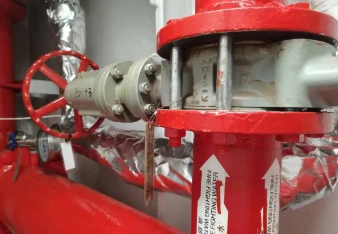
The main function of fire isolation valves
The main function of the isolation valve is to isolate the fire water on the deck and engine room, as well as the passenger and cargo areas, which are usually kept open. At this time, the ship can be provided with fire water by the main fire pump, emergency fire pump, and international shore connection.
When the main fire pump is supplying water
The isolation valve is open, and both the deck and engine room are equipped with fire water.
The isolation valve is closed, and the main fire pump only supplies water to the engine room.
When the emergency fire pump supplies water
The isolation valve is open, and the cargo and cabin compartments are equipped with fire water
Isolation valve closed, only providing fire water to the open area
When supplying water at the international shore connection
The isolation valve is open, and the entire ship has fire water
The relevant isolation valve is closed, and the shore foundation only supplies water to the open area
What are the inspection points for fire isolation valves?
Is the fire isolation valve installed according to the position indicated in the fire control diagram. Incorrect setting of fire isolation valves may result in the effectiveness of the entire water extinguishing system in critical situations.
Are the crew familiar with the working principle of isolation valves, the function of isolation valves, the direction of fire water when the isolation valves are open and closed, and the corresponding area of the valves.
Have the crew maintained and serviced the isolation valve itself as required, frequently opening and closing it, and whether the isolation valve can achieve complete isolation. After closing the isolation valve, the ship can be required to start the emergency fire pump and randomly test the water output of the engine room fire hydrant. If the fire hydrant has pressure to output water, it means that the isolation valve cannot completely isolate. In severe cases, it can be used as a retention defect.
We have more marine engines available......