
01 Global electrification industry ecosystem is accelerating formation
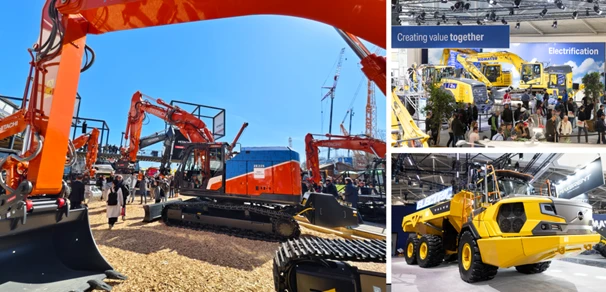
At this exhibition, almost all globally renowned construction machinery manufacturers have released and showcased their electrification product lines. Undoubtedly, electrification has become an important technological route for zero emissions in construction machinery.
Among the companies exhibiting under the theme of electrification, the most eye-catching ones are Volvo Construction Equipment and Hitachi Construction Machinery.
Volvo Construction Equipment, in collaboration with Volvo Trucks, showcased their "all in one" electrified products at the bauma 2025 exhibition. The battery powered models range from mini and compact track excavators and wheel loaders, to medium-sized wheel loaders, wheel excavators, 23-ton track excavators, and the world's first battery powered A30 articulated truck, demonstrating its determination and action to lead the industry's green transformation.
Hitachi Construction Machinery and its European joint venture KTEG exhibited a total of 9 zero emission models, including 8 electric motor models, covering excavators ranging from 1.7-14 tons of track and wheel excavators. This is also the largest electric excavator product line exhibited by Hitachi Construction Machinery in history.
At the bauma 2025 exhibition, electrification is not limited to the excavator and loader product lines, but is accelerating its penetration into an increasing number of sub categories of construction machinery: from light equipment such as vibrating flatbed compactors, small excavators, small loaders, sliding loaders, excavator loaders, and dump trucks, to lifting equipment such as mobile cranes, crawler cranes, and telescopic arm forklifts, to concrete machinery such as concrete mixer trucks and concrete pump trucks, road machinery such as pavers and rollers, to rotary drilling rigs, open-pit drilling rigs, horizontal drills, and finally to super large mining excavators and mining trucks. The breadth and depth of electrification of construction machinery worldwide continue to expand.
Although the electrification process of European construction machinery is far below expectations and there are still challenges in promoting its application in the European market in the short term, it has not stopped global construction machinery manufacturers from continuing to invest in the field of electrification of construction machinery.
While promoting the design and development of electrified complete machine products, manufacturing enterprises are also continuously building an electrified ecosystem. This includes DC and AC charging solutions, battery swapping solutions, mobile power packs, mobile energy storage charging devices, etc.
XCMG, Sany, Liugong and other Chinese construction machinery manufacturers also showcased their electrification and green themes at this year's bauma exhibition. Green construction machinery from China became a highlight of the exhibition.
In the future, it is worth looking forward to whether electrified construction machinery can become the mainstream of the global high-end market, especially in Europe and America.
02 Diversified power solutions in parallel, moving towards a zero emission future
On a global scale, compared to the rapidly developing electrification technology, the development momentum of internal combustion engine technology remains strong.
Due to the differences in non-road emission standards and end-user needs in different regions around the world, future power solutions in the non-road sector will present a diversified pattern.
In the eyes of industry insiders, internal combustion engines will be an important power route for non-road construction machinery for a long time to come.
With the upgrading of emission standards in different regions around the world, the advancement of internal combustion engine and exhaust treatment technology, low-carbon renewable and alternative fuel internal combustion engines such as diesel, renewable diesel, biodiesel, natural gas, biomethane and bioethanol will become important transition options for non-road machinery to move towards zero emission solutions.
In addition to electric and hybrid construction machinery, hydrogen internal combustion engine technology has become one of the hottest topics at this year's bauma exhibition. Although it is still early to talk about commercial applications, some have predicted that hydrogen fuel internal combustion engines will become the ultimate solution for construction machinery to move towards net zero emissions. At this exhibition, Liebherr released a prototype L566 H wheel loader equipped with a self-developed hydrogen fuel engine, Hitachi Construction Machinery launched a 30-ton ZE300H2 excavator prototype equipped with a Deutz hydrogen fuel engine, and Manitou released an MRT 2260 H2 hydrogen fuel cell power telescopic arm forklift prototype. The debut of these products is an important step in the commercial application of hydrogen energy technology in non- road fields.
On multi fuel power platforms, engine manufacturers have already established technical reserves. Cummins has released the 15-liter X15 engine platform, becoming a model for multi fuel engine platforms. At the same time, Caterpillar, John Deere, Liebherr, JCB, Diwanlun, Deutz, Yangma, Kubota and others also presented low-carbon and zero carbon power solutions at this exhibition.

03 Transform from equipment manufacturer to service provider
The competition in the global construction machinery industry is no longer limited to product level and equipment itself. More and more manufacturers are focusing on creating customer-oriented equipment lifecycle services, transforming from simple manufacturers to "manufacturing+service" providers.
At this exhibition, high-quality and long-lasting products are still important carriers, but in addition to product displays, global construction machinery giants have showcased their respective services and technical solutions. Caterpillar not only showcased its CVA customer value agreement, certified overhaul projects, proactive maintenance and other aftermarket service options, but also showcased digital solutions such as VisionLink, online parts store, SIS2GO, as well as operation assistance technology applied to different construction scenarios, remote control, semi-automatic or fully automatic technology, compaction technology, personnel monitoring technology, leveling technology, load monitoring technology and many other intelligent and automated solutions.
In the field of mining equipment, the transformation of mining equipment manufacturers into service providers is even more significant. At this exhibition, while showcasing its latest crushing and screening equipment, Meizhuo also highlighted its complete range of wear parts products and continuously expanding digital solutions. Sandvik also showcased consumables and replacement parts such as drilling tools, drill bits, and digging tools (such as bucket teeth) used in rock drilling rigs and underground loaders. Manitowoc, a global crane giant, not only released multiple innovative crane products, but also highlighted its product support, smartphones, customized modifications, and training services. It is reported that Manitowoc's market revenue will reach 629 million US dollars after 2024, an increase of 67% compared to 2020, exceeding the CRANES+50 strategic goal (non-new aircraft business revenue will increase by 50% compared to 2020).
Industry insiders say that global construction machinery industry giants are further solidifying customer relationships and extending the service attributes of their products (Equipment as a Service, also known as EaaS Equipment as a Service) by investing in aftermarket services and a portfolio of digital, intelligent, and automated technology service products. They are building a new value system that is "derived from products, higher than products".
Relatively speaking, the focus of Chinese manufacturers' displays at this exhibition is still mainly on the product level. From the perspective of product power, Chinese brands have been able to compete on the same stage as global construction machinery giants.
So, next, while making good products, Chinese companies also need to strengthen their layout and accelerate their actions in the industrial chain and value chain.

04 Breaking through the encirclement, the globalization of Chinese brands is fully launched
During the bauma exhibition, the United States announced an increase in tariffs on China to 145%. After the sudden announcement, the global construction machinery market was in an uproar.
Undoubtedly, in the past few years, the global trade war has gradually escalated. Outside of the United States, the United Kingdom has launched anti-dumping and countervailing investigations into Chinese excavators and plans to impose tariffs of up to 83.5%, while the European Union has imposed anti-dumping tariffs of up to 49.3% on Chinese made aerial work platforms. Under numerous obstacles, the globalization of China's construction machinery industry is facing severe challenges.
But the greater the resistance to Chinese brands going global, the greater the motivation. In the past few years, the globalization of Chinese construction machinery manufacturers has been advancing rapidly. Sany Heavy Industry, Zoomlion Heavy Industry Science and Technology Co., Ltd., and Liugong Group Co., Ltd. will achieve a record high of 64%, 51%, and 46% of their international market sales revenue in 2024, respectively.
At this bauma exhibition, Chinese brands have achieved fruitful results. XCMG signed a batch contract for 300 excavators; Signed a large order with SARENS, the world's second-largest lifting giant, and successfully delivered a 250-ton all ground crane; The exhibits were sold out. A total of 3-billion-yuan worth of intention orders were signed at the Sany bauma exhibition; Zoomlion received over 1 billion yuan in potential orders just two days before the exhibition. Liugong has reached purchase orders and cooperation agreements with multiple global clients. In overseas markets, even high-end markets in Europe and America, Chinese products are being increasingly accepted and recognized by customers.
However, in the long run, the globalization of Chinese construction machinery manufacturers is a long and arduous task.
Although compared to previous bauma exhibitions, Chinese companies represented by Sany, XCMG, Zoomlion, LiuGong, and Lingong have seen an increase in popularity. But overall, there is still a lot of room for improvement in the influence of Chinese brands in overseas markets. The number of visitors at the booths of Chinese companies naturally cannot match that of home hosts such as Liebherr, Wittgen, Wacker Neuson, and BorgWarner, and there is also a certain gap compared to international giants such as Caterpillar, Volvo Construction Equipment, Komatsu, and Hitachi Construction Machinery. In Europe, the brand influence of Chinese companies is clearly not strong enough.
"While Chinese products are being paid for by global customers, brand internationalization and service internationalization are the key factors for the next few years, "said a senior executive of a Chinese company.
From conversations with senior executives from multiple domestic and foreign manufacturers of complete machines and components, a generally consistent conclusion has been reached: regionalization of global industrial and supply chains is the trend. The global manufacturing industry pattern is accelerating its restructuring. In this context, the globalization of Chinese enterprises must shift from short-term export trade to a more long-term and systematic "globalization+localization" layout.
Germans speak German, when in Rome do as Romans do. In overseas markets, Chinese companies can learn from the Chinese strategies of some foreign-funded enterprises, that is, to persistently invest in manufacturing localization, service localization, talent internationalization, and supply chain globalization with a mindset and actions of Local for Local and Region for Region, while continuously deepening relationships with local partners. Only in this way can Chinese brands integrate into the high-end markets of Europe and America.
Good news keeps coming. During the bauma exhibition, XCMG announced a series of localization measures in Europe; Not long ago, Zoomlion announced investment in the construction of a high-altitude operation machinery factory in Hungary; At the dinner party for the European customers of Lingong Heavy Machinery, foreign employees and customers accounted for the majority
The internationalization of Chinese construction machinery manufacturers will not stop. After a series of adjustments, the globalization of China's construction machinery industry will be fully launched, and the competitive advantages, competitive landscape, and future global construction machinery market pattern of China's construction machinery industry will be rewritten.