
In recent years, the infrastructure construction in the Middle East has flourished, opening up a vast market space for China's engineering machinery exports. Among them, Saudi Arabia, the United Arab Emirates, Turkey and other countries, as important economies in the Middle East, are becoming the core markets for China's construction machinery exports.
Data shows that the export value of construction machinery from China to Saudi Arabia was only 810 million yuan in 2020, and has climbed to 3.6 billion yuan by 2023, with a compound annual growth rate of 64.7%. In 2024, Saudi Arabia and the United Arab Emirates both entered the top ten of China's construction machinery exports, ranking sixth and ninth respectively, highlighting strong growth potential.
The rapid growth in demand for construction machinery in the Middle East is mainly due to the sustained efforts in infrastructure construction and the real estate industry. Large and medium-sized excavators, concrete equipment, and cranes have become key selling equipment in the market. Taking 2024 as an example, China will export approximately $400 million worth of lifting machinery, $310 million worth of excavation machinery, and $150 million worth of mixing and stirring machinery to Saudi Arabia; The export of lifting machinery to the United Arab Emirates is about 260 million US dollars, and the export of mixing machinery is about 80 million US dollars. These data intuitively reflect the strong demand for construction machinery in the Middle East market.
Facing this market full of opportunities, leading domestic construction machinery enterprises such as Zoomlion, XCMG Group, Sany Heavy Industry, and LiuGong have actively laid out their strategies and achieved remarkable results. Zoomlion has established branch offices to gain a deep understanding of local market demand and develop targeted products, occupying a leading position in the field of engineering cranes; XCMG Group has demonstrated strong market competitiveness through its extensive sales and service network, as well as product design that adapts to the unique environment of the Middle East; Sany Heavy Industry has achieved significant growth in sales performance with its rich and diverse product line; Liugong has steadily increased the market share of loaders in the local market through deep cooperation with UAE companies. The successful practices of these enterprises have set an example for the development of Chinese construction machinery in the Middle East market.

In 2024, Sany Group reached an agreement worth $1.87 billion with Saudi Global Ports SGP.
Specifically, let's take a look at the future infrastructure potential in the Middle East region.
Saudi Arabia, as the largest infrastructure market in the Middle East, has particularly remarkable development prospects.
Saudi Arabia's "Vision 2030" outlines a grand blueprint for infrastructure construction, with an estimated $1.2 trillion in infrastructure investment to be released over the next decade. At the same time, as the Saudi Public Investment Fund (PIF) shifts its investment focus to the domestic market, and large-scale infrastructure projects will continue to emerge, effectively promoting rapid development in the transportation and housing sectors.
According to a Fitch report, Saudi Arabia's infrastructure industry is expected to maintain a stable growth trend until 2034, with an estimated growth rate of 3.6% in 2025 and 4.2% in 2026.
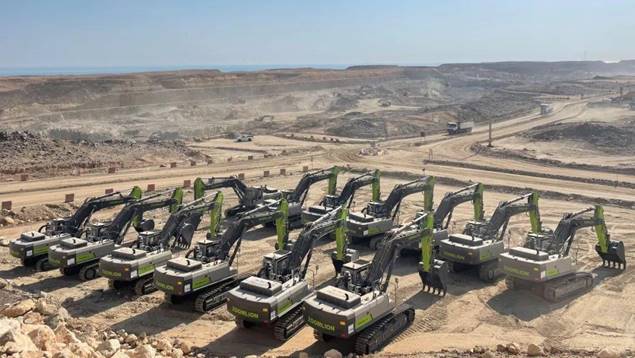
Zoomlion excavator in NEOM New City, Saudi Arabia
In the field of transportation infrastructure, based on the continuous growth of demand for highway and railway construction, it is expected that the average annual growth rate will reach 4.2% from 2025 to 2034. The Saudi government is vigorously promoting the construction of highways, railways, and rail transit in major cities, and the modernization of internal roads in cities will also receive significant financial support.
The field of housing construction also has broad prospects, with an expected growth of 4.4% by 2025. By 2034, both residential and non-residential construction industries will maintain stable growth, and the construction of multifunctional entertainment complexes, hotels, and tourism infrastructure will become important development directions.

XCMG crawler crane builds 2034 World Cup home stadium in Middle East
The United Arab Emirates, with a stable political environment and sustained economic growth, has strong development momentum in multiple fields such as transportation, energy, and housing construction, making it a highly attractive country for investment in the Middle East.
In terms of transportation infrastructure construction, the United Arab Emirates has enormous potential, with numerous transportation projects launched one after another, and the sea, land, and air transportation network becoming increasingly perfect. In 2024, the UAE's investment in the transportation sector jumped from $6.6 billion in 2023 to $12.3 billion, almost doubling in growth.
The housing construction industry is also active. In recent years, residential, commercial, and industrial buildings in the UAE have developed rapidly with strong government support. In June 2024, the UAE government approved a citizen housing assistance program with a total amount of 1.6 billion dirhams (approximately 440 million US dollars), further promoting the prosperity of the housing market.
Turkey, according to its 2025 national budget, will invest 221.3 billion Turkish lira (about 6 billion euros) in the railway sector as an important part of its long-term railway development strategy. This ongoing investment plan aims to double the size of the country's railway network within 30 years, covering high-speed mainline construction, regional railway modernization, and logistics hub expansion.
In the field of highways, the goal is to build over 4,000 kilometers of expressways between 2023 and 2035. Turkey plans to take the opportunity of highway network expansion to establish multiple logistics centers in Istanbul and southeast Anatolia.
However, it should be noted that Turkish infrastructure capacity ranks second in the world, second only to China. Even infrastructure projects built in Africa, the Middle East and other regions have a strong tendency to catch up with China.

On August 15, 2004, Liugong Türkiye distributor Uygunlar opened its new outlet
Currently, the Middle East region has become a strategic new highland for foreign trade enterprises to break through the tariff dilemma between China and the United States, relying on the triple advantages of policy dividends, infrastructure needs, and energy links. With the continuous deepening of the the Belt and Road initiative, China's cooperation with the Middle East countries will continue to reach a new level. Chinese enterprises are expected to usher in greater development opportunities in the Middle East market and write a more brilliant chapter in this dynamic market.