
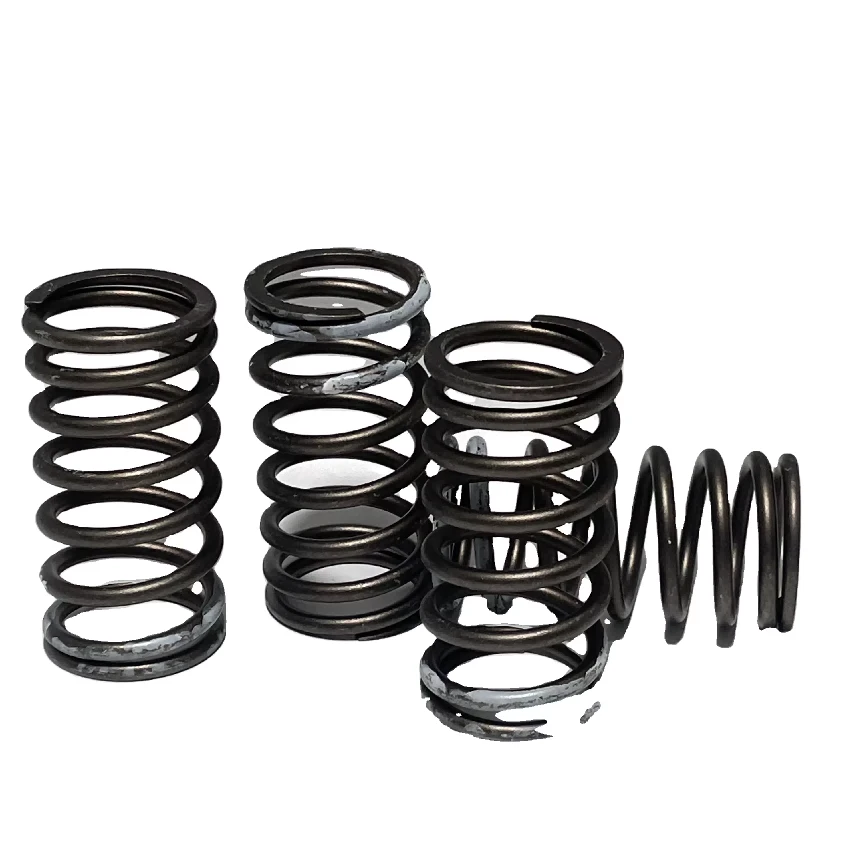
The valve spring is located between the cylinder head and the spring seat at the end of the valve stem. The function of the valve spring is to ensure that the valve can tightly fit with the valve seat or valve seat ring when the valve is closed, and to overcome the inertial force generated by the valve mechanism when the valve is opened, so that the transmission parts are always controlled by the cam and do not detach from each other.
Valve springs are often made of high-quality alloy steel wire and undergo heat treatment to improve their fatigue strength. To avoid spring corrosion, the surface of the spring should be galvanized and phosphated. The two ends of the spring must be ground flat and perpendicular to the spring axis to prevent the spring from tilting during operation.
Valve springs are mostly cylindrical spiral springs. When the working frequency of the valve spring is equal to or a multiple of its natural frequency, the valve spring will resonate and the probability of breakage will increase. To prevent resonance, variable pitch springs can be used, and currently most engines use concentric dual springs. The rotation direction of the inner and outer springs is opposite, and the stiffness of the outer spring is greater than that of the inner spring. Double springs not only prevent resonance, but also shorten the length of the spring. In addition, when one spring breaks, the other spring can continue to work, preventing the valve from falling into the cylinder.
The method of breaking
Because the valve spring bears torque during operation, the stress distribution on its circular cross-section is uneven. The stress gradually increases from the origin near the center to each point on the edge, and the surface experiences the highest stress. In terms of surface points, the inner surface bears the highest stress and is subjected to plane stress. Therefore, once there is a defect on the surface of the valve spring, it is possible to generate the maximum stress concentration at the defect location, leading to early fracture of the spring.
Reason for breakage
The reason for valve spring fracture, in addition to manufacturing defects, improper use may also cause early damage. The common reasons are as follows:
① There are pitting and corrosion pits on the surface of the spring. Improper storage can cause corrosion pits on the surface of the spring. When the spring is subjected to high torque, stress concentration can easily occur at the corrosion pits, ultimately leading to fatigue fracture of the spring.
The quality inspection method for new valve springs: clamp the spring on a vise and compress it to the minimum length, so that there is no gap between the rings as much as possible, and keep it for 48 hours. If there are defects on the surface of the spring, it will break after this compression treatment. This is because the internal stress of the spring is highly concentrated near the defect, causing the spring to break.
The strength of valve spring elasticity can be identified by comparison method. The specific method is to first connect the old valve spring being inspected in series with a new valve spring, and separate them with a steel washer in the middle. Then apply a certain amount of pressure on a valve spring and observe the degree of compression of the new and old springs. If the elasticity of the old spring is insufficient, it must be pressed down first.
② The centerline of the spring is skewed. If the two end faces of the valve spring are not perpendicular to the centerline of the spring, the spring will work at high speed for a long time, and its metal material is also prone to fracture due to fatigue. The method for checking the verticality of valve springs is to first place the spring vertically on a flat plate, use a square ruler to rest on the bottom circle of the spring, then rotate the spring once and measure the maximum distance between the top circle of the spring and the square ruler. Normally, the inclination distance of the valve spring to the vertical line is 1.0-1.5mm. If it exceeds this value, it is best to replace it with a new one.
③ Valve guide movement or loose camshaft bearings. If the valve guide moves during use, it may cause the valve spring to break due to bending stress when compressed. Loose camshaft bearings can cause resonance in valve springs and also lead to their breakage.
④ Improper operation or installation. During the operation of a diesel engine, if the speed suddenly changes frequently, the frequency of compression and extension of the valve spring will suddenly increase, leading to fatigue fracture.
⑤ The valve spring was not assembled as required. When assembling valve springs, some models have special requirements. For example, the Isuzu 6BBl diesel engine requires the blue side of the spring to face the flat surface of the cylinder head. Otherwise, the spring is prone to breakage.
Emergency Management
If the valve spring of a diesel engine is found to be broken while driving, the broken spring can be removed first, and then the working surfaces at both ends of the spring can be reinstalled for temporary use. If the spring breaks into several sections, the adjustment bolts of the intake and exhaust valves of the cylinder can be removed to keep the valves closed. Then, the high-pressure oil pipe of the fuel injection pump leading to the cylinder can be removed to prevent it from injecting fuel into the cylinder, allowing the car to continue driving to the destination.
Inspection steps
(1) Check the free length of the valve spring. Measure the free length of the valve spring with a caliper, and its value should meet the standard value. If it does not meet the requirements, it should be replaced.
(2) Check the verticality of the valve spring. Use a square ruler and a flat plate to check the verticality of the valve spring. Its value should meet the standard value, otherwise it must be replaced.
(3) Check the preload of the valve spring. Use a force gauge to detect the preload force of the valve spring, and its value should meet the standard. If the preload force is lower than the standard value, the valve spring should be replaced.
(4) To prevent damage, the spring should be compressed frequently.