
New orders increased by 14 vessels month-on-month, with Chinese shipyards securing the highest number of contracts and South Korea ranking second.
According to the latest data from Clarksons (as of July 9, 2026), global new ship orders in June 2026 totaled 227 vessels, amounting to 5,757,152 CGT. Compared to May 2026, when global new orders reached 213 vessels totaling 5,865,646 CGT, the number of vessels increased by 14, while corrected gross tonnage decreased by 1.85%. Year-on-year, compared to June 2025's 300 vessels totaling 5,157,339 CGT, the number of new orders declined by 73 vessels, but corrected gross tonnage rose by 11.63%.
By vessel type, new orders included: 70 bulk carriers with a total deadweight of 5,933,000 tons; 28 tankers with a total deadweight of 7,341,000 tons; 26 chemical tankers with a total deadweight of 8,233,000 tons; 55 container ships with a total capacity of 205,299 TEUs; 13 liquefied gas carriers with a total capacity of 1,614,000 cubic meters; 25 other types totaling 469,208 CGT; and 10 offshore vessels totaling 258,271 CGT.
In terms of order types: bulk carriers included 11 Cape-sized, 12 Panama-sized, and 47 large Handy-sized vessels; tanker orders comprised 21 VLCCs, 2 Suezmax tankers, and 5 Aframax tankers; container ships included 27 Panama-sized, 3 sub-Panama-sized, 19 Handy-sized, and 6 feeder-sized vessels.
By country of shipyard: in June 2026, global new orders amounted to 227 vessels totaling 5,757,152 CGT. Chinese shipyards secured 192 vessels totaling 4,786,161 CGT; Japanese yards received 5 vessels totaling 89,251 CGT; and South Korean yards secured 15 vessels totaling 641,483 CGT. These accounted for 83.13%, 1.55%, and 11.14% of global corrected gross tonnage, respectively.
From January to June 2026, new ship orders totaled 1,644 vessels with a combined deadweight of 137,505,226 tons. This represents an increase of 8.37% in vessel count and 124.66% in deadweight compared to the same period in 2025, which recorded 1,517 vessels and 61,205,869 deadweight tons.
By vessel type during the first half of 2026: 294 bulk carriers with a total deadweight of 28,120,448 tons; 298 tankers with a total deadweight of 65,798,238 tons; 137 chemical tankers with a total deadweight of 4,951,340 tons; 388 container ships with a total capacity of 2,095,184 TEUs; 135 liquefied gas carriers with a total capacity of 15,544,300 cubic meters; 192 offshore vessels totaling 1,594,500 CGT; and 200 other vessels totaling 4,318,810 CGT.
By country: China secured 1,183 new orders totaling 31,551,780 CGT; Japan received 39 orders totaling 689,659 CGT; and South Korea secured 197 orders totaling 8,066,107 CGT.
These accounted for 71.92%, 1.57%, and 18.39% of global corrected gross tonnage, respectively.
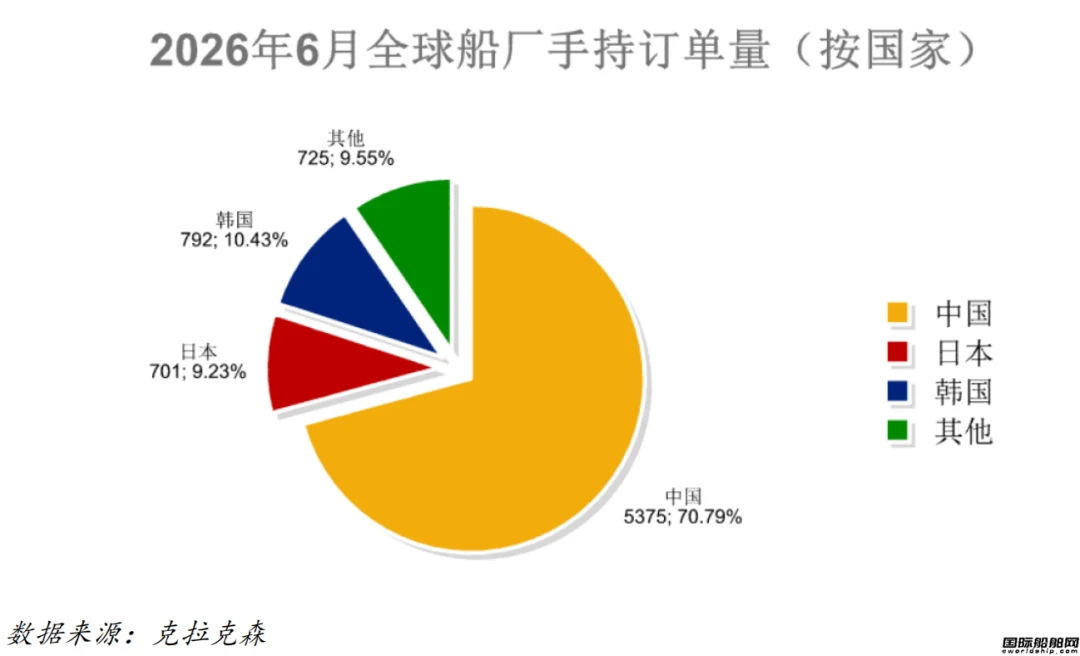
Global backlogged orders stand at 7,593 vessels, with Chinese shipyards accounting for 5,375 of them-representing 70.79% of the global market share.
According to statistics, as of July 9, 2026, global shipyards had 7,593 orders on hand, totaling 206,591,874 CGT. Compared with the 7,585 orders on hand as of June 9, 2026, totaling 204,447,013 CGT, the number of orders on hand increased by 0.11% on a month-on-month basis, and the total tonnage increased by 1.05% on a month-on-month basis.
Among them, the number of orders on hand for Chinese shipyards was 5,375, totaling 13,619,0561 CGT, accounting for 70.79% of the global market share and 65.92% of the total tonnage; the number of orders on hand for Japanese shipyards was 701, totaling 12,731,165 CGT, accounting for 9.23% of the global market share and 6.16% of the total tonnage; the number of orders on hand for Korean shipyards was 792, totaling 38,270,301 CGT, accounting for 10.43% of the global market share and 18.52% of the total tonnage.
From the main ship types, the number of orders on hand for bulk carriers was 1,649, totaling 151,005,936 deadweight tons; the number of orders on hand for oil tankers was 1,818, totaling 181,655,456 deadweight tons; the number of orders on hand for container ships was 1,704, totaling 13,113,162 TEU.
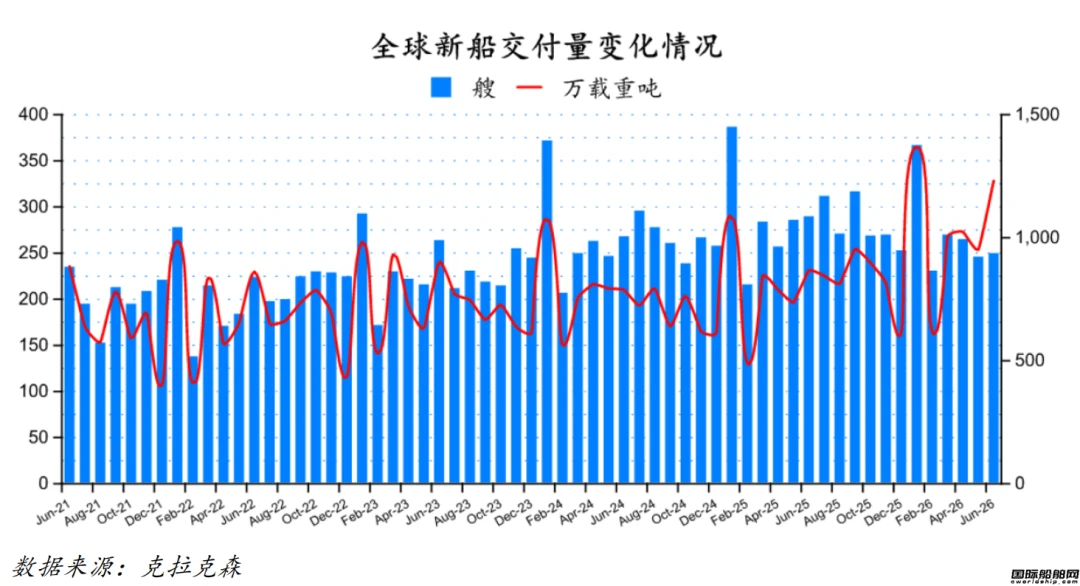
The completed ship delivery volume increased by 29.49% compared with the previous month. The delivery of bulk carriers and chemical tankers was the highest.
In June 2026, a total of 249 new ships were delivered by global shipyards, with a total deadweight of 12,315,039 tons. Compared with the 245 new ship deliveries in May 2026, the number increased by 1.63% and the deadweight increased by 29.49%. Compared with the 289 new ship deliveries in June 2025, the number decreased by 13.84% and the deadweight increased by 41.84%.
From the ship type perspective, the delivery quantity of bulk carriers was 43, with a total deadweight of 3,295,437 tons; the delivery quantity of container ships was 24, with a total of 194,527 TEUs; the delivery quantity of oil tankers was 31, with a total deadweight of 4,044,138 tons; the delivery quantity of chemical tankers was 35, with a total deadweight of 878,086 tons; the delivery quantity of liquefied gas carriers was 19, with a total volume of 2,270,380 cubic meters; the delivery quantity of offshore vessels was 53, with a total deadweight of 93,707 tons; and the delivery quantity of other ship types was 44, with a total deadweight of 444,199 tons.
From January to June 2026, a total of 1,623 new ships were delivered by global shipyards, with a total deadweight of 62,028,834 tons. Compared with the global new ship delivery orders of 1,714 ships and a total deadweight of 48,177,846 tons in the same period of 2025, the number decreased by 5.31% and the deadweight increased by 28.75%.
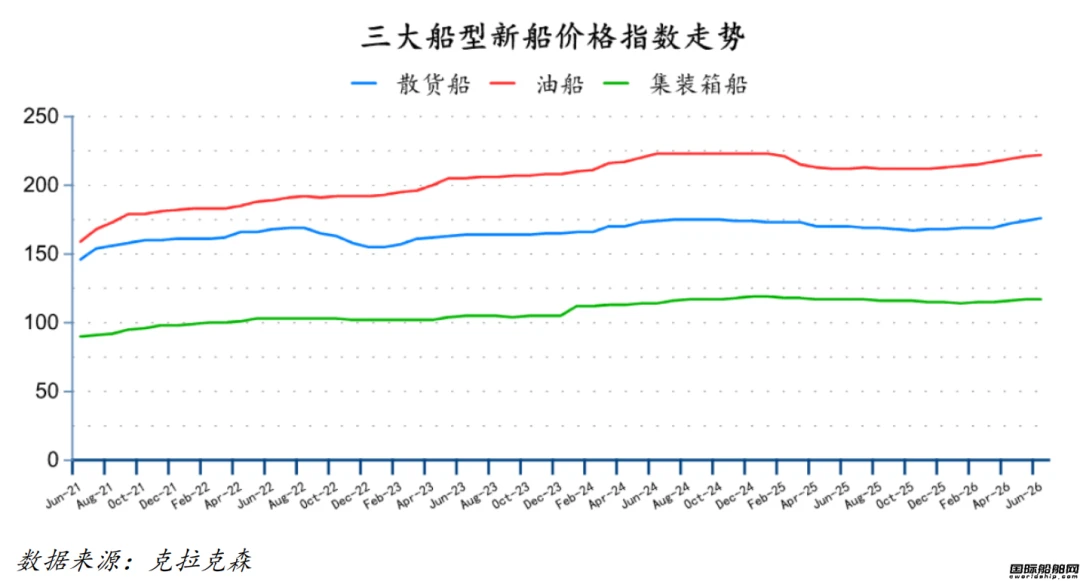
The prices of bulk carriers and oil tankers have risen, while the price of container ships has remained stable.
In June, the new ship price indices of bulk carriers and oil tankers rose by 2 points and 1 point respectively compared with the previous month to 176 points and 222 points; the new ship price index of container ships remained unchanged compared with the previous month, at 117 points.
In June, the new ship prices of various types of bulk carriers rose compared with the previous month. Among them, the new ship prices of Capesize bulk carriers (180/182 KDWT), Panamax bulk carriers (75/77 KDWT), Panamax-type bulk carriers (61/64.5 KDWT), and Panamax-type bulk carriers (25/30 KDWT) rose by $500,000, $500,000, $500,000 and $450,000 respectively to $76 million, $38 million, $35 million and $27.83 million.
The new ship prices of oil tankers, except for Aframax oil tankers (113-115 KDWT) and Panamax oil tankers (47-51 KDWT) whose new ship prices rose compared with the previous month, the new ship prices of other types of oil tankers rose or remained unchanged compared with the previous month. Among them, VLCC (315-320 KDWT), Suezmax oil tankers (156-158 KDWT) and Panamax oil tankers (73-75 KDWT) remained unchanged compared with the previous month, with new ship prices of $130.5 million, $89.5 million and $61.5 million respectively; Aframax oil tankers (113-115 KDWT) and Panamax oil tankers (47-51 KDWT) new ship prices rose by $500,000 to $75 million and $51.5 million respectively.
The new ship prices of container ships, except for Panamax container ships (8500-9500 TEU) whose new ship prices rose compared with the previous month, remained unchanged compared with the previous month for other types of container ships. Among them, Panamax container ships (8500-9500 TEU) new ship prices rose by $500,000 to $1.3 billion; Ultra Panamax container ships (22,000-24,000 TEU and 13,000-13,500 TEU), Panamax container ships (4,000-4,500 TEU), Sub-Panamax container ships (27,000-30,000 TEU) and Panamax container ships (18,000-21,000 TEU and 10,000-12,000 TEU) new ship prices remained unchanged, with new ship prices of $2.615 billion, $1.73 billion, $610 million, $450 million, $32.75 million and $25.25 million respectively.