
PIL has finalised a new round of orders for 13,000 TEU dual-fuel container ships worth over 10 billion yuan. Due to the high order backlog and tight shipyard capacity at Chinese shipyards, PIL had to split the order between Chinese and South Korean shipyards as it could not secure earlier delivery slots. According to TradeWinds, PIL plans to order eight 13,000 TEU dual-fuel New Panamax container ships, with four each to be built by Hudong-Zhonghua and South Korea's Hyundai Heavy Industries. The cost of each vessel and the exact delivery schedule have not been disclosed, but shipbrokers estimate that each ship could cost up to 190 million US dollars, with a total value of around 1.52 billion US dollars (approximately 10.6 billion yuan) for the eight ships. The delivery time is expected to be concentrated in late 2028 and early 2029.
For reference, Clarksons' data shows that the current price of a new 13,000-14,000 TEU LNG dual-fuel container ship is around 171.5 million US dollars, a 7% decline compared to 185 million US dollars in the same period last year.
PIL launched a newbuilding tender in November last year, planning to order 4 to 8 LNG dual-fuel 13,000 TEU container ships and requesting Chinese and South Korean shipyards to submit quotations. Participating shipyards included Yangzijiang Shipbuilding, Guangzhou Shipyard International, Hudong-Zhonghua, Jiangnan Shipyard, China Merchants Heave Industry , as well as South Korea's Hyundai Heavy Industries and Hanwha Ocean (formerly Daewoo Shipbuilding).
Industry insiders said that PIL's decision to order new ships was to maintain its competitiveness amid the expansion of its competitors' fleets. Notably, PIL chose to place four orders with South Korean shipyards not because of quality or cost factors, but because Chinese shipyards' order books were already full and earlier delivery slots were unavailable.
If this order is confirmed, it will be PIL's first order for new ships from South Korean shipyards in nearly 15 years. The company's last newbuilding contract with South Korea was in 2011 when it ordered three 3,566 TEU and four 2,800 TEU feeder vessels from Hyundai Samho and Hyundai Mipo.
In recent years, PIL has consistently placed orders with Chinese shipyards. In 2022, after completing its restructuring, PIL returned to the newbuilding market after a seven-year hiatus, ordering four 14,000 TEU dual-fuel LNG-powered container ships from Jiangnan Shipyard and four 8,000 TEU dual-fuel vessels from Yangzijiang Shipbuilding. All eight ships have been delivered.
In August 2024, PIL ordered five 13,000 TEU dual-fuel vessels from Hudong-Zhonghua, each costing over 190 million US dollars, with delivery expected between 2026 and early 2029. In November 2024, PIL returned to Hudong-Zhonghua to order five 9,000 TEU dual-fuel vessels, each reportedly costing slightly over 140 million US dollars. In July 2025, PIL added two more vessels of the same type.
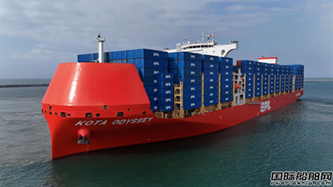
It is understood that PIL was founded by Mr. Cheong Yoon Chong in 1967 and is now the largest shipping company in Southeast Asia and one of the top 12 container shipping companies in the world. The company operates a fleet of about 100 container ships, providing shipping services and solutions to over 500 destinations in 90 countries worldwide. Its business focuses on China, Asia, Africa, the Middle East, Latin America, Oceania, and the Pacific Islands.
According to the latest data from Alphaliner, PIL's fleet currently operates 100 vessels, including 82 owned and 18 chartered, with a total capacity of approximately 440,000 TEU, ranking 12th globally with a market share of 1.3%. Additionally, PIL has 23 newbuilds under construction, totaling 220,000 TEU, accounting for 50.6% of its current capacity.
Last year, new orders for container ships once again set a historical record. Chinese shipbuilders continue to expand their lead, securing over 70% of global orders. According to Clarksons, new orders for container ships in 2025 reached a record high of 644 vessels with a capacity of 4.759 million TEU, surpassing the previous record of 4.674 million TEU set in 2024.
Chinese shipbuilders continue to lead the global container shipbuilding market. As of December 30, 2025, Clarksons' statistics show that almost all new container ship orders in 2025 were taken by Chinese and South Korean shipbuilders, with Chinese shipbuilders signing orders for 518 vessels with a capacity of approximately 3.446 million TEU, accounting for 72% of the market.
This unprecedented "order boom" has also raised concerns in the industry about future overcapacity. Filipe Gouveia, General Manager of Shipping Analysis at the Baltic and International Maritime Council (BIMCO), pointed out that the current backlog of container ship orders as a proportion of the existing fleet has reached 33%, and expressed concerns about the large-scale new capacity that will be delivered in the near future.
Gouveia said, "From the perspective of the development of supply and demand balance, the huge backlog of container ship orders is one of our greatest concerns, especially when the Red Sea/Suez Canal route returns to normal operation, the container shipping sector will face the greatest risk of demand decline." He further predicted that the growth of container shipping capacity will continue to outpace demand growth in the next five years.