
1,The function of the diesel engine cooling system
The heat generated by the combustion of diesel fuel in the cylinder is only partially converted into useful work. The rest is either discharged into the atmosphere with the exhaust gas or transferred to the surrounding cooling medium through the cylinder, piston, cylinder head, etc.
The quality and quantity of these cooling media, as well as the cooling conditions, must be appropriate to ensure that the working temperatures of the above components remain normal. Otherwise, if the temperatures of these components rise sharply, the following serious consequences will occur:
(1) The strength of the components will significantly decrease, causing damage.
(2) The components will expand due to heat, which will disrupt the normal clearance between parts and generate thermal stress. Both of these will cause damage.
(3) The temperature of the combustion chamber components is too high, reducing the intake density and intake volume, thereby reducing the power of the diesel engine.
(4) The lubrication conditions deteriorate. The viscosity of the lubricating oil decreases or even deteriorates, which will cause severe wear of the components and also affect the sealing performance of the combustion chamber.
The cooling of the diesel engine is not necessarily more intense, but the cooling degree must be appropriate. Only in this way can the diesel engine work normally and have good economic performance.
2, Cooling Medium
(1) Air is used for wind cooling in small diesel engines for land use.
(2) Water is widely used. It can be fresh water or seawater.
(3) Lubricating oil is used to cool the pistons of some large diesel engines.
(4) Some systems use diesel to cool the fuel injectors.
3,Main Types of Water Cooling Systems
(1) Open Cooling System
In an open-cycle cooling system, water is directly introduced into the diesel engine to cool the heated parts. Depending on the application, the water is then discharged to external waterways, rivers, lakes, or the ocean. In some cases, it is discharged to a cooling tower or spray pond, where the hot water is cooled and then pumped back to the diesel engine. In this case, water must be replenished to make up for evaporation losses. In all open systems, calcium and other minerals in the water will form scale in the water jacket, and descaling should be done regularly. The advantage of this system is that the equipment is simplified.
(2) Closed Cooling System
In a closed-cycle cooling system, the same cooling water is recirculated. For vehicle and construction diesel engines, the water that has absorbed heat from the diesel engine is cooled through a radiator, with a fan drawing air to cool the water. For marine diesel engines, seawater or lake water is passed through a heat exchanger called a freshwater cooler to lower the temperature of the cooling water passing through it. For industrial stationary diesel engines, water from urban waterways or artesian wells is passed through a heat exchanger to cool the circulating water of the diesel engine.
The advantage of this system is that the diesel engine uses pure water or chemically treated water in a closed cycle, so almost no scale forms in the water jacket. Additionally, the cooling water temperature can be appropriately increased, resulting in better economic performance for the diesel engine. However, its disadvantage is that it complicates the structure and layout of the cooling system. This system is widely used in modern diesel engines of various powers.
4,Small Diesel Engine Cooling System
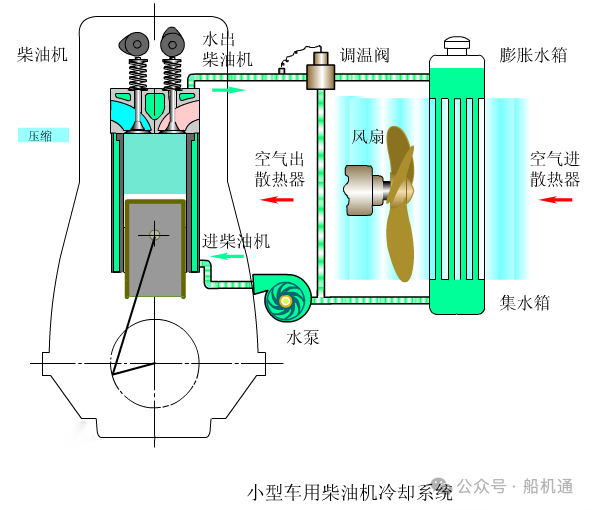
The following figure shows the closed water cooling system for diesel engines used in automobiles and tractors. Its main components include a cooling water pump, radiator, fan, and automatic thermostat, etc. The radiator is composed of an expansion tank, radiator tubes, and a water collector, etc. Hot water from the diesel engine, when flowing through the radiator tubes, has its heat dissipated by the air flow generated by the fan, and the water temperature drops before entering the water collector. The water in the water collector is drawn out by the cooling water pump and pumped into the cylinder liner of the diesel engine to cool the cylinder and piston, and then enters the cylinder head to cool the fuel injector and exhaust valve, etc. The automatic thermostat is installed at the inlet of the radiator and controls the amount of cooling water flowing into the radiator according to the water temperature at the outlet of the diesel engine, thereby regulating the temperature of the cooling water entering the diesel engine. The functions of the expansion tank are as follows:
(1) To provide room for thermal expansion and contraction in the cooling water circuit. When the temperature of the cooling water rises, its volume expands and the water level in the expansion tank rises; when the temperature drops, the volume reduces, or when there is a leak in the water circuit, the expansion tank replenishes the water.
(2) When the cooling water is heated and its temperature rises, gas (steam) may separate and adhere to the cylinder wall, which can cause poor heat transfer in the cylinder and local overheating. The highest point of the outlet pipe is connected to the upper part of the expansion tank, allowing these gases to escape into the atmosphere.
(3) When the cooling water temperature is high, it is prone to vaporization at the low-pressure area near the suction port of the water pump. The expansion tank is set at a certain height above the center of the water pump suction port. The static pressure head of the water in the expansion tank keeps the suction port of the water pump at a higher water pressure, thus preventing vaporization.
5,Cooling System for Medium-sized Diesel Engines
The cooling system shown in the following figure is mostly used for medium-sized land-based stationary diesel engines and marine diesel engines. The softened water exits the diesel engine and enters the softened water cooler. Its heat is absorbed and carried away by the natural water passing through it. The amount of water entering the cooler is controlled by the temperature regulator. The cooled softened water is pumped into the diesel engine by the softened water pump, cooling the heated components. At the highest point of the diesel engine outlet pipe, there is a pipe leading to the expansion water tank. On this tank, there are vent pipes, supply pipes, suction pipes for the softened water pump, and a liquid level gauge, etc. The function of the expansion water tank is the same as described earlier. The natural water is sucked in from natural sources (such as ditches, rivers, lakes, or the ocean) by the natural water pump and pumped to the lubricating oil cooler and the softened water cooler to cool the lubricating oil and the softened water, and then discharged from the system. The softened water pump and the natural water pump are generally driven by the diesel engine itself, and an independent electric backup pump is provided for each. However, there are also diesel engines that only have the softened water pump and the natural water pump is driven by an electric motor. In this case, a single shared backup pump can be set up, but the piping configuration should enable the backup pump to replace either the softened water pump or the natural water pump.

6, Large Diesel Engine Cooling System
The following figure illustrates the water cooling system for the cylinder liner of a large ship diesel engine. The water from the outlet of the main fresh water pump is cooled by the desalination machine or the fresh water cooler, and then enters the main cylinder liner water inlet main pipe at the bottom of each cylinder. It cools the cylinder liner, the cylinder head, and the turbocharger. The water from each cylinder outlet pipe is collected and one route passes through valve A (opened during navigation, closed during berthing) to enter the air separator, then enters the main fresh water pump inlet, and the other route leads to the expansion water tank. The water tank has a balancing pipe to replenish water for the system and maintain the suction head of the fresh water pump.
The figure also shows the cooling water system for the power generation diesel engine (auxiliary engine). It is arranged in parallel with the main engine cooling water system. During navigation, it can be circulated separately (at this time, valves A and C are open, valve B is closed). During berthing, the auxiliary engine cooling water can be used to warm the main engine cylinder (at this time, valves A and C are closed, valve B is opened). The temperature controller is used to automatically adjust the inlet temperature. The two main fresh water pumps are centrifugal pumps, one in use and one as a backup.
